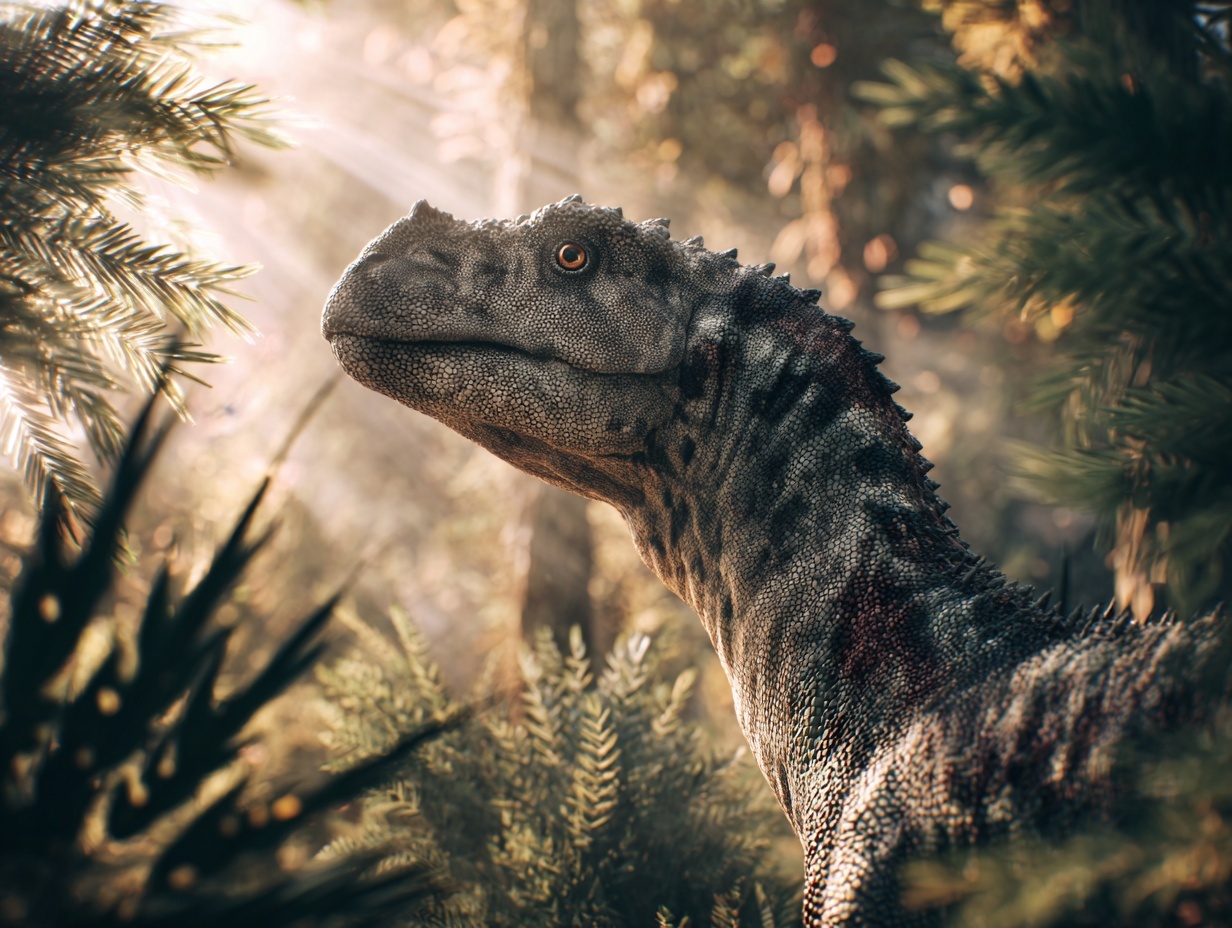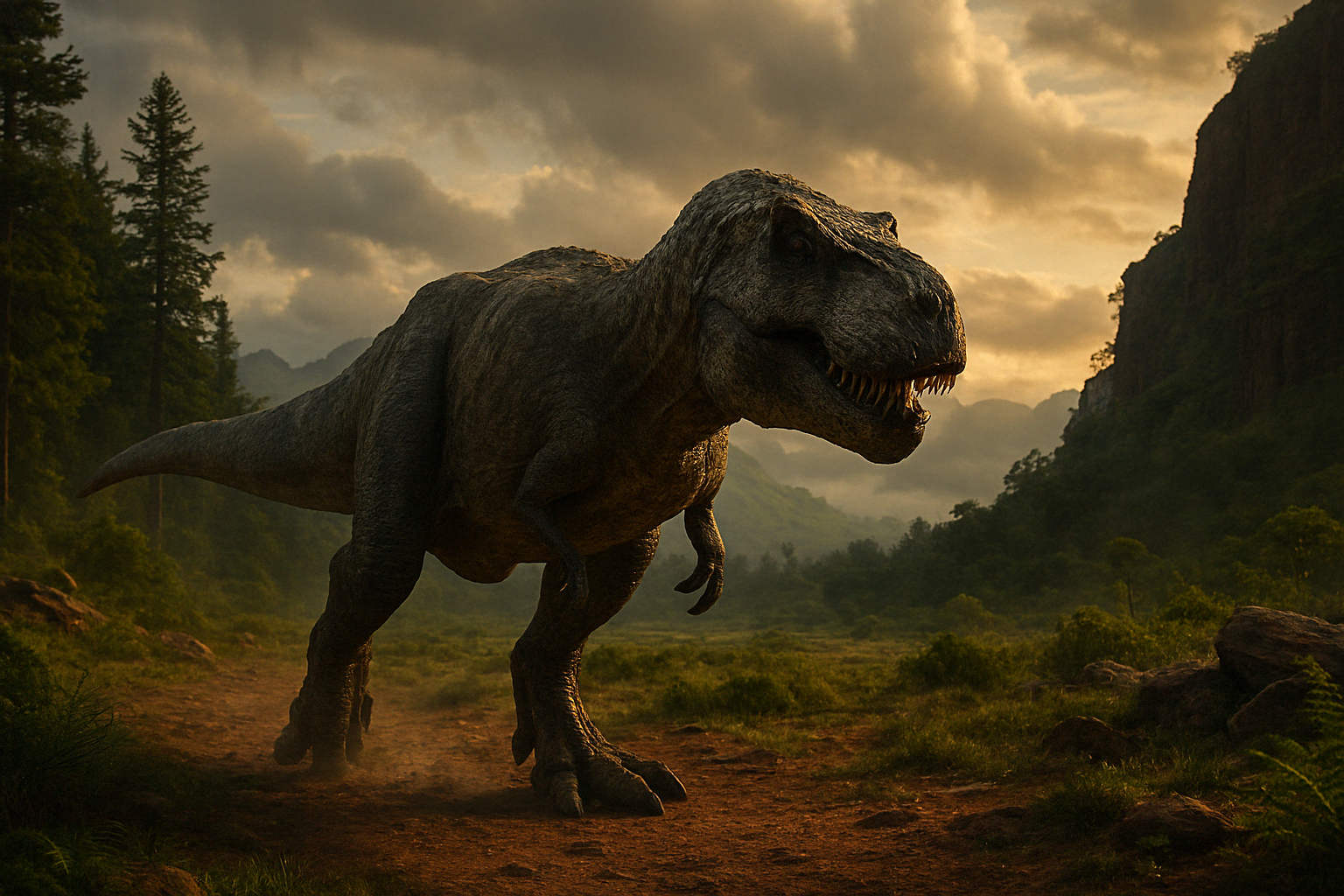
Spinosaurus was probably the longer animal, about 14 m against 12 m for T. rex, but T. rex stood taller at the hips and the two weights are too close to call. They also never met. Spinosaurus lived in North Africa 99 to 94 million years ago; T. rex lived in North America 68 to 66 million years ago.
So the real question is not who wins. It is how big each one was, and how sure anyone can be. The honest answer is “less sure than the internet sounds”, and the reasons are the interesting part.
T. rex vs Spinosaurus size: the side-by-side
Every figure here is from the Natural History Museum (London) Dino Directory pages for Tyrannosaurus and Spinosaurus, which call them estimates.
| Tyrannosaurus rex | Spinosaurus | |
|---|---|---|
| Length | 12 m (the biggest known, Sue and Scotty, almost 13 m) | 14 m (an estimate; no complete skeleton) |
| Weight | 7,000 kg (a normal one was probably 5,000 to 7,000 kg; the biggest over 8,000 kg) | 7,400 kg |
| Height | 3.5 to 4.0 m at the hips | Sail about 1.5 m high, but short hind legs, so lower at the hips |
| Lived | Late Cretaceous, 68-66 million years ago | Late Cretaceous, 99-94 million years ago |
| Where | Canada and the USA | Egypt and Morocco, North Africa |
| Ate | Other animals | Fish, and maybe other dinosaurs |
| Named | Osborn, 1905 | Stromer, 1915 |
| Name means | tyrant lizard | spine lizard |
Which one was bigger: longer, heavier or taller?
Longer: Spinosaurus, by about 2 m on the museum’s numbers. Heavier: a coin toss. The museum lists 7,000 kg for T. rex and 7,400 kg for Spinosaurus, but it also says a normal T. rex was probably 5,000 to 7,000 kg and the biggest, Sue and Scotty, topped 8,000 kg. Spinosaurus has no complete skeleton, so its weight carries a bigger question mark than T. rex’s. Taller at the hips: T. rex, because Spinosaurus had short hind legs. Its sail stood about 1.5 m high.
That is three contests and two winners, which is not the verdict a headline wants. For a wider chart with a dozen dinosaurs on one scale, see our dinosaur size comparison.
Could T. rex and Spinosaurus have fought each other?
No. Using the museum’s date ranges, the last Spinosaurus (about 94 million years ago) was gone more than 25 million years before the first T. rex (about 68 million years ago), and they lived on different continents. Want the full cast of characters? The types of dinosaurs guide sorts them by group.
If you force the cage match anyway, you only get half a comparison. The museum describes the T. rex bite as the strongest of any known land animal, three to five times more powerful than a lion’s, from about 60 teeth up to 20 cm long. For Spinosaurus it lists fish as the food, and maybe other dinosaurs, in a habitat of tidal flats and mangrove forests. Nobody has a number for how those two would have gotten on, because they did not.
What we still do not know about Spinosaurus
More than we would like. The first bones were found in 1912 and named by Stromer in 1915, and the museum says they were accidentally destroyed during the Second World War. Even with newer finds, no complete skeleton exists. That is why the length is only an estimate. Whether it walked on two legs or four is listed as unresolved, and the sail has several proposed jobs: regulating body temperature, display to mates, or helping to push through water.
Then there is the swimming argument. In 2020 an international team including University of Portsmouth researchers argued in Nature that Spinosaurus used its fleshy, spined tail to power through water like an eel, making it a fully aquatic hunter. In 2022 Paul Sereno of the University of Chicago and Frank Fish of West Chester University argued the opposite in eLife. Their model said Spinosaurus was too buoyant to submerge regularly, that submerging would have taken 15 to 25 times the estimated power of its tail, and that its swimming power was an order of magnitude less than an alligator’s. They call it a semiaquatic ambush predator that worked the edges of coastal and inland waters. The University of Chicago’s write-up of the 2022 study lays out both sides.
So which is it? Newer studies keep it going: a 2025 Yale study in Current Biology argued from limb proportions for a highly aquatic Spinosaurus, and a 2026 Science paper on a new inland species, Spinosaurus mirabilis, was reported as supporting a wading, semiaquatic animal. Both sides have published data, and the argument is still running. If a site tells you flatly that Spinosaurus was an underwater hunter, or flatly that it was not, it is picking a side. For more on the debate over what it ate and how, our Spinosaurus guide is a place to start.
What we still do not know about T. rex
T. rex is arguably the best-known meat-eater of all, and the museum still lists open questions: whether it hunted in packs, what its tiny arms were for, and whether it had feathers (there is no direct evidence). Size varies a lot between skeletons, and most were probably smaller than Sue and Scotty. The best-known part of its story begins with Barnum Brown, who found two skeletons, in 1900 and 1902, the first in Wyoming. Osborn named the animal in 1905. Earlier bones had been named Manospondylus gigas by Edward Drinker Cope in 1892.
Want the kid-friendly tour? Start with our T. rex facts and pictures guide. And if you want a third giant to throw in the ring, Giganotosaurus is listed at 13 m and 13,800 kg, though the museum also calls T. rex the “bulkier and heavier” of the two, so that weight is doubtful.
T. rex and Spinosaurus questions people ask
Was Spinosaurus bigger than T. rex? Longer, probably, by about 2 m. Heavier is too close to call, and T. rex was taller at the hips.
Did they live at the same time? No. Spinosaurus lived 99 to 94 million years ago in North Africa. T. rex lived 68 to 66 million years ago in North America.
Was Spinosaurus a swimmer? Probably in the water at least some of the time. How much, and how well, is the live debate.
Figures checked on 31 October 2026 against the Natural History Museum and the University of Chicago pages linked above. Dino Directory numbers are estimates and the museum updates them.