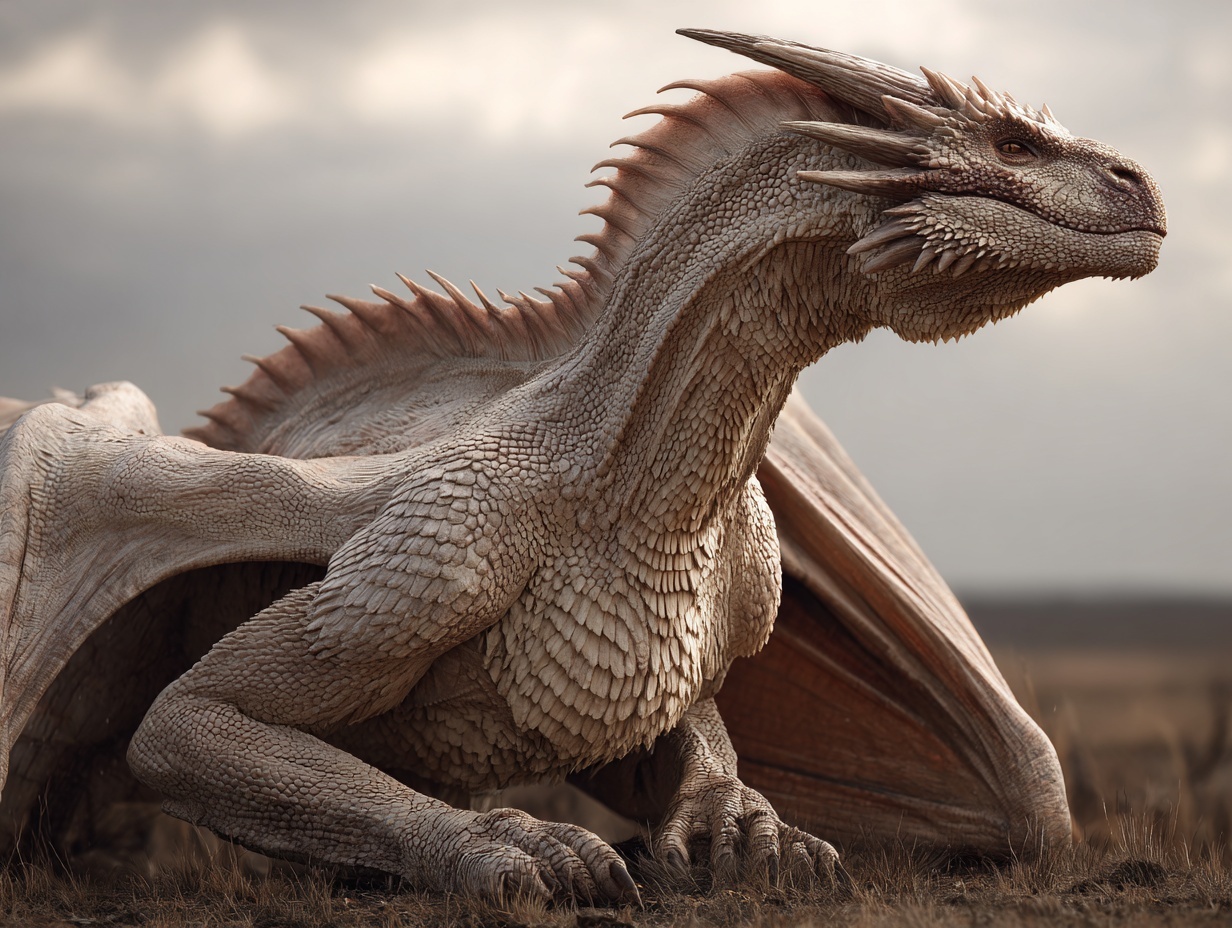
The dinosaurs on this chart run from 0.7 metres long (Compsognathus) up to an estimated 35 metres (Argentinosaurus), using the Natural History Museum’s Dino Directory figures, and every one of those numbers is an estimate. They are not the extremes: the same directory lists Patagotitan at 37.5 m and Anchiornis at 0.6 m. The chart below draws them to scale. Under it, the part most size charts leave out: which numbers are shaky, and why.
A normal size chart gives you one tidy number per dinosaur and a silhouette next to a person. Tidy is the problem. Most of the biggest animals here are known from incomplete skeletons, so the “35 m” or “22 m” is a best guess, not a measurement someone took with a tape.
Dinosaur size comparison chart: length, weight and when each one lived
Lengths and weights are the figures in the Natural History Museum (London) Dino Directory, which labels them estimates. Where the museum gives no number, the cell says so. The bars are all drawn against the longest animal on this chart, Argentinosaurus. The grey bar is a 1.7 m adult, a yardstick and not a museum figure.
| Animal | Length, to scale | Length | Weight | Lived (million years ago) | Where |
|---|---|---|---|---|---|
| You (about 1.7 m, a yardstick) | 1.7 m | ||||
| Compsognathus | 0.7 m | 3 kg | 145-140 | France, Germany | |
| Microraptor | 0.8 m | 1 kg | 120 | China | |
| Velociraptor | 1.8 m | 7 kg | 74-70 | Mongolia | |
| Ankylosaurus | 8 m | 8,000 kg | 68-66 | Canada, USA | |
| Stegosaurus | 9 m | not given | 152-145 | USA | |
| Triceratops | 9 m | 10,000 kg | 68-66 | USA | |
| Tyrannosaurus rex | 12 m | 7,000 kg | 68-66 | Canada, USA | |
| Giganotosaurus | 13 m | 13,800 kg | 100-95 | Argentina | |
| Spinosaurus | 14 m | 7,400 kg | 99-94 | Egypt, Morocco | |
| Brachiosaurus | 22 m | 46,900 kg | 152-145 | USA | |
| Diplodocus | 26 m | 15,000 kg | 152-145 | USA | |
| Argentinosaurus | 35 m | 70,000 kg | 90 | Argentina |
Want the family tree behind these names? The types of dinosaurs guide sorts the famous ones into groups, and the dinosaur names and pictures guide covers how to say them.
Longest, heaviest and tallest are three different contests
Look at Diplodocus and Brachiosaurus. Diplodocus is the longer one on the chart, 26 m against 22 m, and the museum notes that it may have been one of the longest dinosaurs ever partly because of its very long tail. Brachiosaurus is the heavier one by a mile: 46,900 kg against 15,000 kg. Long and heavy are not the same thing, which is exactly why the Brachiosaurus vs Diplodocus debate never ends.
Same trick with Triceratops. At 9 m it is shorter than T. rex (12 m), but the museum lists it at 10,000 kg against 7,000 kg for the tyrant. Giganotosaurus is listed at 13 m and 13,800 kg, which would beat T. rex on both counts, but the museum’s own text calls T. rex the “bulkier and heavier” animal, so treat that weight with caution. The T. rex row shows a typical animal, by the way. The museum says the biggest T. rex skeletons, nicknamed Sue and Scotty, were almost 13 m and over 8,000 kg, and that most T. rex were probably smaller than those two.
Why every dinosaur size number comes with a shrug
Count the animals on this chart that have no complete skeleton. The museum says so for Brachiosaurus, Giganotosaurus, Ankylosaurus and Spinosaurus, and says Argentinosaurus is hard to size because its fossil remains are incomplete. For Brachiosaurus it adds that some experts think the bones came from an animal that was not fully grown, so the real animal might have been a bit bigger than today’s estimates.
Giant and famous, then, and still reconstructed from pieces. Fine. That is how this works. Scientists estimate from the bones they have, using equations that link limb bone size to body mass, or by building a digital model of the skeleton. Here is how far two honest methods can drift apart even when the skeleton is nearly complete.
How scientists get a weight out of bones (and why two methods can disagree)
The Natural History Museum in London has an exceptionally complete Stegosaurus skeleton, catalogue number NHMUK R36730. In 2015 Charlotte Brassey, Susannah Maidment and Paul Barrett published two weight estimates for it in the journal Biology Letters. A digital model of the skeleton, shrink-wrapped by software (a “convex hull”), gave 1,560 kg, with a 95% prediction interval of 1,082 to 2,256 kg. Equations that work from limb bone measurements gave 2,355 to 3,751 kg.
Look at those ranges again. The top of the first one (2,256 kg) is below the bottom of the second one (2,355 kg). They do not even overlap. Same skeleton, two respectable methods, and the answer depends on which one you trust. That is a nearly complete Stegosaurus in a London museum. Now picture the same argument over an animal known from partial remains. You can see why Argentinosaurus weights always come with a hedge. You can read the Stegosaurus mass paper for the method details.
Dinosaur time is bigger than dinosaur size
Look at the “lived” column. Stegosaurus is listed at 152 to 145 million years ago, and T. rex at 68 to 66 million years ago. From the last Stegosaurus to the first T. rex is about 77 million years (145 minus 68). From the last T. rex to today is about 66 million years. So T. rex lived closer in time to you than to Stegosaurus. That is simple arithmetic from the museum’s date ranges, and it moves a little depending on whose dates you pick, but the direction does not change.
The small end of the chart
At the other end sit the animals you could carry. The museum lists Compsognathus at 0.7 m and 3 kg, and Microraptor at 0.8 m and 1 kg. Microraptor was a small feathered dinosaur with wings on its legs as well as its arms, and the museum says it could probably properly fly, like a modern bird, with shiny black feathers.
Velociraptor, at 1.8 m and 7 kg, is a famous size mix-up. The museum notes that the Jurassic Park films recreated it at about twice its actual size, and that it is now thought to have had a fine feather-like covering. Our Velociraptor guide goes through what is and is not known.
Dinosaur size questions people ask
What was the biggest dinosaur? Nobody can say for sure. Argentinosaurus is the longest on this chart (about 35 m and 70,000 kg, from Argentina about 90 million years ago), but its remains are incomplete. The same museum lists Patagotitan at 37.5 m and 57,000 kg and names Argentinosaurus and Puertasaurus as other contenders.
Was T. rex the biggest meat-eater? Not by length. Spinosaurus is listed at 14 m and Giganotosaurus at 13 m, against 12 m for a typical T. rex. Weight is less clear, because the museum’s Giganotosaurus figure conflicts with its own text. We put the two most famous contenders head to head in T. rex vs Spinosaurus.
How tall were dinosaurs compared with a person? The museum gives T. rex as 3.5 to 4.0 m tall at the hips, which is about two to two and a third times the height of a 1.7 m adult, measured at the hips only, before you add the neck and head. Treat that comparison as rough.
Figures are from the Natural History Museum’s Dino Directory pages for Argentinosaurus, Tyrannosaurus and Spinosaurus and the other species in the table, checked on 31 October 2026. Real dinosaur pictures of the bones themselves are the subject of our real dinosaur pictures guide.