Short version: Giganotosaurus was about 13 metres (43 feet) long by the Natural History Museum’s estimate, which makes it one of the largest known land predators. But it never met T-Rex: Giganotosaurus lived in South America, long before T-Rex lived in North America.
Giganotosaurus vs T-Rex
Giganotosaurus was about 13 metres (43 feet) long, lived about 98 million years ago in the Late Cretaceous, and its fossils come from what is now Argentina. T-Rex lived in North America, long after. The skeleton is incomplete, so treat the length as an estimate. To see more giants lined up together, try our dinosaur size comparison.
Giganotosaurus or Gigantosaurus?
Two different names. Giganotosaurus (with the “no”) is the huge South American predator on this page. Gigantosaurus, spelled without it, was once given to a long-necked, plant-eating dinosaur and is no longer used as a valid dinosaur name. It is also the title of a children’s cartoon series.
Who Would Win, Giganotosaurus or T-Rex?
There is no real answer. They lived on different continents, far apart in time. Nobody knows how fast Giganotosaurus ran or how it hunted, and its skeleton is incomplete, so any winner would be a guess. Max’s encounter below is fiction.
Max’s Field Notes
Day20something – Tyrannosaurus Rex may be the king of the dinosaurs, but Giganotosaurus gives it a serious run for its money. Giganotosaurus was a huge predator that lived in South America long before T-Rex lived in North America. My encounter with this predator didn’t just challenge what I thought I knew about dinosaur dominance—it set off a chain of events that followed me back to the present.
Quick Facts About Giganotosaurus
Here’s what makes this massive carnivore one of the most terrifying predators ever:
- Name Meaning: Giganotosaurus means “giant southern lizard.”
- Time Period: Lived about 98 million years ago during the Late Cretaceous.
- Size: The Natural History Museum estimates its length at about 13 metres (43 feet); the incomplete skeleton makes exact comparisons uncertain.
- Diet: Carnivore; its exact prey and hunting behavior remain uncertain.
- Habitat: Open plains and forests in what is now Argentina.
Max’s Encounter: The Bigger Predator
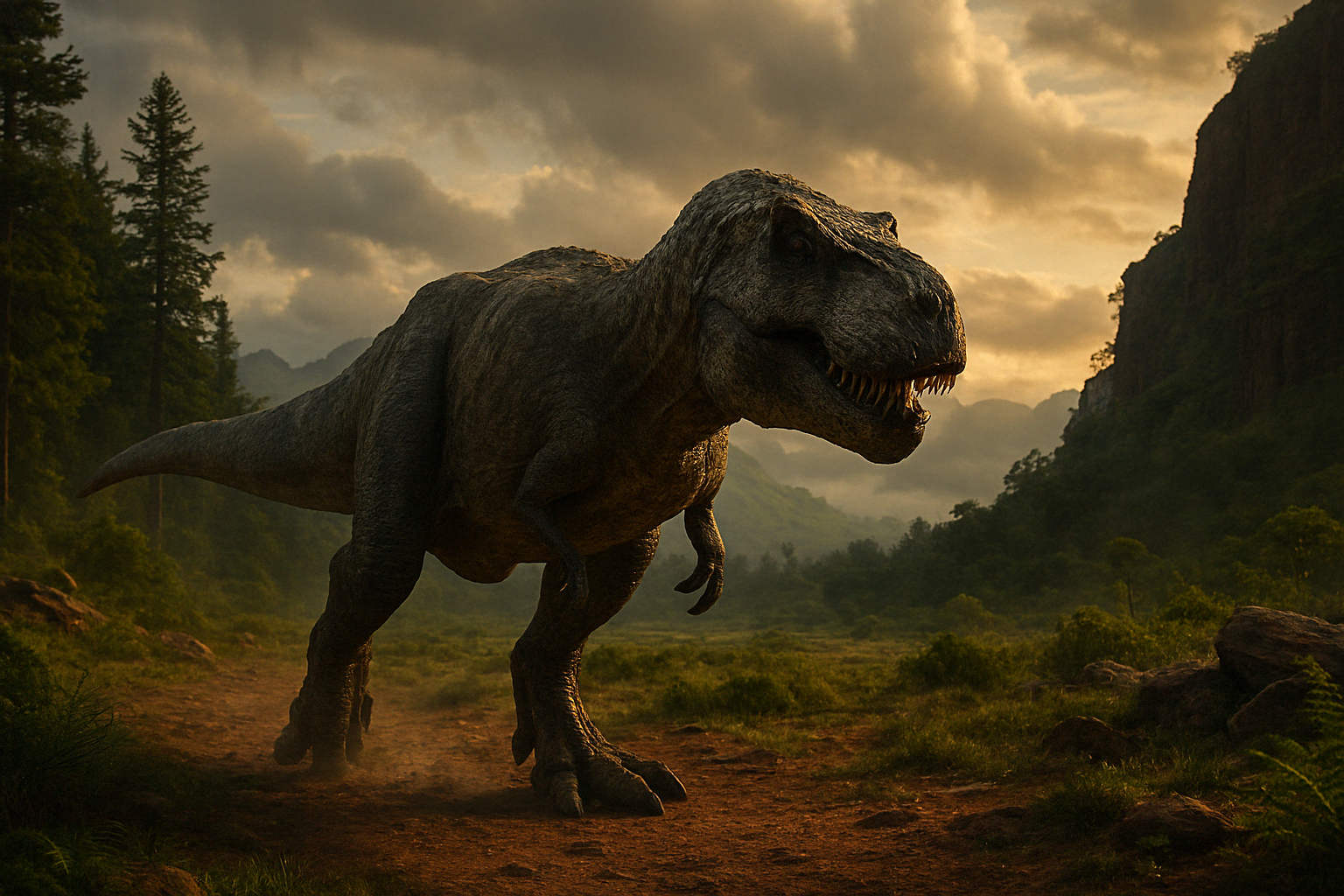
I was in a wide, open plain, following massive footprints pressed into the dirt. Each one was over three feet wide, leading to a distant hill where a lone Giganotosaurus stood, surveying its territory. It was massive, its body rippling with muscle as it stomped forward, jaws slightly open.
I crouched low, trying to stay out of sight as I snapped photos. But then the wind shifted, and the Giganotosaurus turned its head, sniffing the air. It let out a deep, guttural roar that sent a flock of smaller dinosaurs scattering—and me scrambling for cover.
Just as it started moving toward me, something unexpected happened. A loud, mechanical whirring sound echoed across the plain. The Giganotosaurus froze, tilting its head toward the noise. Then, to my shock, a small metallic object flew overhead.
It was one of the alien tourists’ devices, hovering silently as it scanned the dinosaur. The Giganotosaurus snapped at it, but the device darted away, disappearing into the sky. I didn’t stick around to see if it came back.
Back in the Present: The Scientist Doubles Down
When I got home, things got worse. Dr. Alvin Grant, the paleontologist who’s been calling my photos fake, posted a scathing article online:
“Max Vale’s so-called dinosaur photography is nothing but a poorly executed digital hoax. His so-called ‘proof’ lacks any physical evidence to support it.”
His article went viral, and suddenly, everyone at school was talking about it—including my crush, Lily. She asked if the article was true, and I didn’t know what to say. How could I prove my photos were real without dragging her into my time-travel mess?
That night, Sam found me sulking in my room. “You can’t let that guy win,” she said. “If the photos aren’t enough, we’ll just have to find something better. What about that treasure map you found?”
She wasn’t wrong. If I could recover Captain Harrow’s gold—or even the “relic of thunder”—I’d have something undeniable. The problem? Shadow Cavern was over 300 miles away, and I didn’t have a car.
“I can drive you,” Sam said with a smirk. “As long as you don’t mind riding with someone who only has their learner’s permit.”
Modern Consequences and Stakes
- The Scientist’s Article: Dr. Grant’s accusations are putting Max’s credibility at risk, making his crush question him and drawing more attention to his adventures.
- Sam’s Learner’s Permit: She’s determined to help Max salvage his reputation but isn’t thrilled about the whole time-travel aspect.
- The Aliens: Their scanning device in the past raises new questions. Are they monitoring Max, or are they trying to control something bigger?
What Makes Giganotosaurus a Rival to T-Rex?
- Size
- Giganotosaurus was among the largest known land predators. It reached about 13 metres (43 feet) by the Natural History Museum estimate, but the skeleton is incomplete, so comparing its size with T-Rex depends on the specimens and estimates used.
- Speed
- Its exact speed and ability to pursue prey over long distances are not established by its fossils.
- Hunting Style
- Its social behavior and preferred prey remain uncertain; fossils alone do not establish coordinated pack hunting.
Did You Know?
- Its intelligence and hunting decisions cannot be reliably determined from a size comparison of brains.
- Its teeth were serrated like steak knives, perfect for slicing through tough hides.
- Giganotosaurus was discovered in Argentina in 1993 and named in 1995, according to the Natural History Museum.
Real Giganotosaurus Pictures
The photo I took shows the Giganotosaurus mid-stride, its head tilted as it roared. Sam called it “the most terrifying thing I’ve ever seen,” and honestly? She’s not wrong.
Max’s encounter is fiction. No illustration is available in this section yet.
Field Notes From Max
- Survival Tip: In my imagined encounter, keeping my distance felt like a good idea; its actual speed remains uncertain.
- What I Learned: Dinosaurs weren’t just rulers of their environment—they were adaptable, specialized predators.
- Favorite Moment: Seeing the Giganotosaurus roar as the alien device scanned it—it was like watching two worlds collide.
The Bigger Picture
Giganotosaurus may not have the fame of T-Rex, but its enormous size makes it just as fascinating. But back in the present, the stakes are rising. Dr. Grant’s article, the treasure map, and the aliens’ strange presence are all converging into something I can’t ignore.
Sam’s plan to drive to Shadow Cavern might be risky, but if Captain Harrow’s treasure is real, it could be the proof I need to silence the doubters—and maybe even win Lily over. The question is, can I make it there before someone—or something—stops me?
Next up: #2A: Mosasaurus Pictures – Meet the King of the Ancient Oceans.
What’s scarier than a giant predator on land? Stay tuned for the time I faced the Mosasaurus, the apex predator of prehistoric seas—and why it might hold another clue to Harrow’s mystery.
More Dinosaur Field Guides
- Tyrannosaurus Rex Facts and Pictures for Kids and Dino Nerds
- Dinosaur Names and Pictures: A Big Starter Guide for Curious Kids and Dino Nerds
- Maiasaura – The Dinosaur Known for Its Excellent Parenting Skills
- Types of Dinosaurs (With the Famous Ones You Actually Search For)
- Types of Dinosaurs (Explained Like You’re on a Field Trip with Max, Jake & Sam)